


How to Identify Air Springs
The number stamped on your air spring often isn't the whole story. Most air springs carry more than one identifier, and the one that's still legible after years under a vehicle usually points to a family of springs — not the specific part you need. This guide explains what the numbers mean across the three main manufacturers we work with, and the fastest way to get the right replacement.
The short version: find any number you can read, then send us photographs of the top and bottom of the spring. We identify air springs every day and would rather confirm the part on a call or over email before anything ships.

Why one number usually isn't enough
Air springs are more complex to specify than they look. The rubber bellows is only one component — the correct assembly also depends on the piston type, the mounting configuration top and bottom, the stroke, and whether there's an internal bump stop you can't see from outside. Two springs can share the same bellows and still be different parts.
That's why manufacturers print more than one number: a family/type number (moulded into the rubber during manufacture) and a specific assembly number (on a label, usually on the top plate). The family number narrows it down; the assembly number confirms it. When the label has perished — which is common after years in service — you're often left with only the family number, and that's where a photo does what a number can't.

Firestone air springs
Firestone air springs carry two numbers:
-
The type number (e.g. 1T15M-6) is moulded into the rubber bellows This tells you the family of air spring — the rubber and construction — but not the specific part. Several different assemblies can share the same type number.
-
The assembly number (W01-M58-xxxx format) is printed on a label on the top of the air spring. This identifies the specific spring — and it's the one we cross-reference to our retail SKU.
If the top label has deteriorated (common — labels don't survive road spray and years of service well), the moulded type number still tells us which family you're in. From there, photographs of the top and bottom mountings let us narrow it to the specific spring. Sometimes the type number leads to only one air spring — but that's not guaranteed, so we confirm rather than assume.

SABO air springs
SABO works the same way, with a different numbering system:
-
The rubber number is a 4-digit code moulded into the bag (e.g. 0640). Like the Firestone type number, this is a family identifier — it tells us the bellows, not the complete part.
-
The specific air spring number is on a label on the top (e.g. SA520640). This is the one we cross-reference to our retail SKU.
If the top label has perished, read the 4-digit number off the rubber and send us photographs of the top and bottom mountings. That combination gives us what we need to identify the exact part.

When one number IS enough
Occasionally a single number does confirm the complete assembly. The Firestone W21-760-9000, for example, has no number moulded into the rubber — instead it has a clamp ring with 9000 stamped on it, and that one number identifies the whole spring with confidence.
But this is the exception, not the rule. Most air springs, once they've been in service, show only one legible number — and that number usually points to a family, not a specific part. Which is why, for most identifications, a couple of photographs are worth more than any single number.
The fastest way: send us photos
We identify air springs every day. If you're unsure — and most people should be — send us:
-
A photo of the top of the air spring (label and mounting)
-
A photo of the bottom (piston/mounting)
-
Any number you can read, off the label or the rubber
You can send these by email or WhatsApp. We'll cross-reference against our catalogue and confirm the right part before anything ships.
We would genuinely rather take the call. Getting it right first time saves you a wrong part, a return, and a vehicle off the road longer than it needs to be.
FAQ
How to Identify Air Springs? — Start with any number you can read: the assembly/part number on the top label, or the type/family number moulded into the rubber. The label number identifies the exact part; the moulded number usually only identifies the family. If the label has worn off, send us photos of the top and bottom of the spring and we'll identify it.
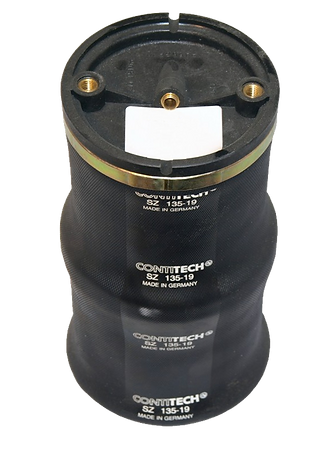
What does the number on the rubber tell me? — On Firestone (e.g. 1T15M-9) and SABO (a 4-digit code) the moulded rubber number identifies the family of air spring — the bellows and construction — not the specific assembly. Several different parts can share it. On Contitech (e.g. SZ135-19) it usually identifies the assembly, but not always — some have a hidden internal bump stop.
The label on top of my air spring has worn off — can you still identify it? — Yes. The number moulded into the rubber tells us the family, and photographs of the top and bottom mountings let us confirm the specific part. This is one of the most common situations we deal with.
What's an internal bump stop and why does it matter? — Some air springs (notably certain Contitech units) contain a rubber bump stop inside the spring that you can't see when it's mounted. Two springs with the same external number can differ only by this. It's confirmed by compressed height, by how the suspension sits, or by inspecting a removed spring.
Can you identify an air spring from just one number? — Sometimes — a few springs (like the Firestone W21-760-9000, numbered on its clamp ring) are confirmed by a single number. But that's the exception. Most in-service springs show only one legible number that points to a family, so we usually ask for photos to confirm.
What photos should I send? — The top of the spring (label and mounting), the bottom (piston/mounting), and a shot of any legible number on the rubber. Send by email or WhatsApp.