


What Is Air Suspension?
Air suspension is a suspension system that uses pressurised air springs — flexible rubber chambers filled with compressed air — in place of, or alongside, conventional steel springs. Because the air pressure can be adjusted, the vehicle's ride height and spring support can be controlled to suit different loads and conditions.
Air springs are also referred to as air bags or air bellows. They're found on everything from premium passenger cars and luxury coaches to motorhomes, commercial vehicles, pickups and industrial machinery, and are fitted as standard from the factory on many vehicles — particularly ambulances, larger motorhomes and some commercial vans.
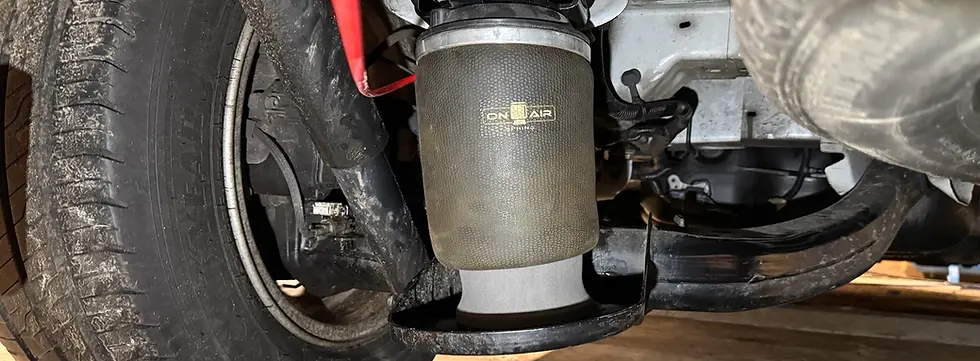
Air suspension is found on everything from premium passenger cars and luxury coaches to motorhomes, commercial vehicles, pickups and industrial machinery. It is also fitted to many vehicles as standard from the factory — particularly ambulances, larger motorhomes and some commercial vans.
There are two fundamentally different types of air suspension upgrade available for vehicles that don't have it fitted from the factory: semi-air suspension and full air suspension. Understanding the difference is the starting point for choosing the right solution.

What Is an Air Spring?
An air spring is the core component of any air suspension system: a flexible, reinforced rubber chamber that holds pressurised air and supports the vehicle's weight in place of — or in addition to — a steel spring. Where a steel spring has a fixed stiffness set at manufacture, an air spring's support changes with its air pressure: more air for heavier loads, less for lighter ones.
Air springs come in two main constructions. Convoluted air springs (single, double or triple convoluted) have a bellows-like shape with one or more lobes, suited to shorter travel and higher load applications. Rolling sleeve air springs use a cylindrical sleeve that rolls over a piston as the suspension moves, giving longer travel and a more progressive rate. Which construction suits a given vehicle depends on the space available, the load and the suspension travel required.
A cushion of pressurised air also absorbs impacts differently to steel or solid rubber — force is distributed progressively across the air volume rather than transmitted through a fixed component. This is why, in many semi-air installations, replacing the original solid rubber bump stops with air springs is a meaningful upgrade in itself.
On Air Suspension stocks a full range of [replacement air springs] for OE and aftermarket systems, alongside our vehicle-specific kits.
Semi-Air Suspension
Semi-air suspension adds air springs to a vehicle that already has conventional steel suspension — leaf springs or torsion bars. The air springs work alongside the existing suspension rather than replacing it entirely.
Semi-air assists your existing suspension. Full air suspension replaces it entirely.
In many applications, the existing bump stops are removed and the air springs are fitted in their place. Bump stops are large rubber buffers mounted between the chassis and axle — their job is to absorb the sudden jolts that occur when the suspension reaches the limit of its travel, such as hitting a pothole or a sharp road imperfection. Replacing a solid rubber bump stop with an air spring is a meaningful upgrade in itself: a cushion of air absorbs and distributes impact far more progressively than a block of rubber.
How Does Semi-Air Work?

Air springs are fitted between the vehicle's chassis and rear axle — in many cases occupying the same space as the original bump stops. When inflated, they add support and lift to the rear of the vehicle, working in combination with the existing leaf springs or torsion bar.
The amount of air can be adjusted to suit the load the vehicle is carrying — more load, more air, less load, less air — keeping the vehicle at a consistent, controlled height regardless of what's in the back.
On a basic manual inflate system, air is added using a standard tyre inflator or workshop compressor. For more convenient day-to-day use, an onboard compressor kit can be fitted so air can be added at the touch of a button. For fully automatic load levelling, a control system with a height sensor will continuously monitor and adjust the ride height without any manual input.
What Semi-Air Suspension Does:
-
Raises the rear under load — counteracts rear sag caused by carrying weight, towing or loading the vehicle to capacity
-
Improves stability — increased roll stiffness reduces body lean when cornering or passing high-sided vehicles in crosswinds
-
Improves rear ground clearance — raises the rear to clear ramps, ferry embarkation ramps, steep driveways and long overhangs
-
Levels an uneven load — on a two-chamber system, left and right air springs can be adjusted independently to level the vehicle when carrying an off-centre load or parked on uneven ground
-
Improves ride comfort — the additional spring support reduces the harshness of impacts transmitted through a heavily laden rear suspension
-
Reduces strain on existing suspension components — by sharing the load, the air springs reduce the stress on the original leaf springs or torsion bar
What semi-air suspension doesn't do: Semi-air cannot lower the vehicle below its standard unladen ride height. It can only raise and support the rear within the limits of the existing suspension travel.
Full Air Suspension

Full air suspension replaces the vehicle's existing springs entirely — the original leaf springs, coil springs or torsion bar are removed and replaced with air springs. This is a more involved conversion than semi-air and carries a higher cost, but it offers a significantly greater range of adjustment and a higher level of ride quality.
Because the original suspension is removed, a full air conversion can both raise and lower the vehicle — not just support it under load. This makes it the appropriate solution where lowering capability is required, where precise and consistent ride height control at all loads is needed, or where ride quality is the primary objective.
Full air suspension is typically found on high-end motorhome conversions, Land Rover Defenders, Ineos Grenadiers, performance vehicles and specialist applications such as ambulances, fire & rescue, wheelchair accessible vehicles, outside broadcast units and delicate load transport.

What Full Air Suspension Does:
-
Raises and lowers the vehicle — full height range adjustment in both directions
-
Maintains consistent ride height at any load — the system adjusts automatically regardless of payload
-
Premium ride quality — the air spring fully replaces the steel spring, eliminating the harshness of conventional suspension under load
-
On-demand access height — lower the vehicle for loading or improved access at the touch of a button
The trade-off: If a full air system develops a fault, the vehicle will drop to its lowest position. Unlike semi-air, there is no conventional spring underneath to fall back on. This makes quality of components and installation critical.
Semi-Air vs Full Air — Which Is Right for You?
For most motorhome and van owners, semi-air is the practical solution — it addresses rear sag, ramp clearance and stability without the cost or complexity of a full conversion, and the original suspension remains as a backup. Full air is the right choice where the vehicle needs to lower as well as raise, where ride quality at all loads is the priority, or where the application demands precision and control that only a full conversion provides.
Why Are Vehicles Fitted with Air Suspension?
Vehicles are fitted with air suspension because it allows the suspension to adapt to the load being carried — something a fixed steel spring cannot do. A vehicle's load can vary enormously between empty and fully laden, and air suspension keeps ride height and spring support consistent across that whole range.
This is why air suspension is factory-fitted to vehicles where loads vary significantly or where a controlled, consistent platform matters: ambulances, coaches, larger motorhomes, commercial vans and delicate load transport. For drivers of larger vehicles, it's also worth knowing that air suspension changes how the vehicle should be operated in some situations — for example, ferry ramps, loading bays and height-restricted areas, where the vehicle's ride height may differ from its usual travelling height.
Quality Matters
Air suspension kits vary significantly in quality. The market includes engineered solutions designed and tested for specific vehicle applications alongside generic budget kits that are not application-specific and are prone to failure. A poorly engineered or poorly fitted kit will not deliver the benefits described above and can introduce new problems.
On Air Suspension designs and manufactures air suspension kits for specific vehicle applications — every kit is engineered, tested and validated for the chassis it is designed for. We also carry out diagnostics and repair on both OE factory-fitted and aftermarket air suspension systems at our Ongar, Essex workshop, including systems fitted by other suppliers.
Which Is Right for My Vehicle?
Semi-air suits: motorhomes and campervans on AL-KO chassis or standard Ducato, Boxer, Relay, Sprinter, VW Crafter, MAN TGE, Iveco Daily and Ford Transit platforms; pickup trucks carrying variable loads; light commercial vehicles regularly near maximum payload; towing applications; any vehicle where rear sag under load is a recurring issue.
Full air suits: Land Rover Defender, Ineos Grenadier and performance 4x4s; premium motorhome conversions requiring full height control; specialist applications, ambulances, fire & rescue including wheelchair accessible vehicles and delicate load transport.
If you're unsure which solution is right for your vehicle, contact our team — we'd rather spend five minutes pointing you in the right direction than have you invest in the wrong solution.
FAQs
What is the difference between semi-air and full air suspension?
Semi-air adds air springs alongside the vehicle's existing steel suspension, which stays in place. Full air suspension removes the original springs entirely and replaces them with air springs. Semi-air supports and raises the rear under load; full air can both raise and lower the vehicle across its full height range.
Are air springs the same as air bags?
Yes — "air spring," "air bag" and "air bellows" all refer to the same component: a reinforced rubber chamber holding pressurised air. "Air spring" is the standard engineering term; "air bag" is the common everyday name.
Does air suspension replace my existing suspension?
Only with a full air conversion. A semi-air kit works alongside your existing leaf springs or torsion bar — nothing is removed, and the installation is fully reversible.
What happens if an air spring fails?
On a semi-air system, the original steel suspension is still in place, so the vehicle remains supported and driveable while the fault is repaired. On a full air system there is no steel spring underneath — a fault will drop the vehicle to its lowest position, which is why component quality and correct installation matter more on full air conversions.
How is air added to the system?
On a basic manual system, through an inflation valve using a standard tyre inflator or workshop compressor. An onboard compressor kit adds air at the touch of a button, and a fully automatic control system uses a height sensor to monitor and adjust ride height continuously without input from the driver.
Can air suspension be repaired?
Yes. Common faults — leaking air springs, damaged air lines, valve or compressor issues — are all diagnosable and repairable. On Air Suspension carries out diagnostics and repair on both OE factory-fitted and aftermarket systems at our Ongar, Essex workshop.